Student Academy
Twelve weeks to stop studying life and start building one.
A mentor-led program where students replace theory with proof — a working mind, a real income attempt, real career conversations, and a capstone built on evidence, not hope.
Apply for the next cohort.
Takes about 4 minutes. No payment information needed — a mentor will follow up personally with cohort dates and next steps.
0
WEEKS
0
PHASES
0
LIVE SESSIONS / WK
0
MENTORSHIP POD
0
LIVE CAPSTONE
Most students graduate with
answers to questions no one is asking
them anymore.
WHAT SCHOOL TRAINS
Memorize and recall on demand
Follow a syllabus someone else wrote
Avoid failure to protect a grade
Wait to be picked, hired, or noticed
Finish with a transcript
WHAT STUDENT ACADEMY TRAINS
Retrieve, apply, and teach what you learn
Design and run your own systems
Treat rejection as data, not damage
Build reputation and go get the conversation
Finish with a Capstone you've already lived
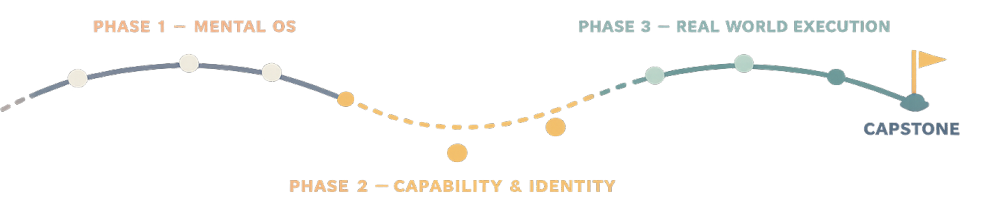
Mental Operating System
Most students study harder, not smarter. This week rewires that — starting with how memory, focus, and neuroplasticity actually work.
- Understand why exposure to information isn't the same as learning it
- Replace passive review with active recall and retrieval practice
- Identify personal cognitive biases and distraction patterns
- Build a first working version of a Personal Learning Playbook
A 7-day time audit forces students to see, for the first time, where their life is actually going.
- Track and analyze real time and energy use, not assumed use
- Build and live-test a structured weekly schedule
- Apply habit stacking to make consistency automatic
- Design and launch a personal 30-Day Productivity System
Motivation runs out. Identity doesn't. Students move from vague ambition to a standard they hold themselves to.
- Distinguish identity-driven behavior from goal-chasing
- Recognize personal self-sabotage patterns and name them honestly
- Practice delayed gratification and emotional regulation under real pressure
- Write a personal Constitution and complete a 7-Day Discipline Challenge
Confidence isn't the same as being right. Students learn to build an argument instead of just asserting one.
- Structure a claim with reasoning and evidence — not volume
- Spot common logical fallacies in real time
- Practice active listening and concise, persuasive expression
- Deliver a live 3-minute persuasive pitch and hold up in structured debate
Capability & Identity Building
Two weeks on the question school never really answers: how does the job market actually decide who gets paid, and for what?
- See how industries generate revenue and where money actually flows
- Understand why degrees signal knowledge but don't guarantee value
- Complete a full industry analysis, mapping skills to income
- Conduct real informational interviews with working professionals
Leadership isn't a title on a badge — it's what a student does when instructions get unclear and no one is in charge.
- Reframe leadership as responsibility taken, not authority granted
- Understand how incentives — not instructions — drive real behavior
- Practice conflict resolution and psychological safety inside a team
- Complete a live team challenge and submit a peer evaluation report
The most direct week in the program: build something, and sell it, in seven days — as a team, for real.
- Apply MVP thinking to build the smallest sellable version of an idea
- Learn the fundamentals of real sales and persuasion
- Reach real customers and generate real outreach and revenue
- Experience real rejection, feedback, and iteration under a deadline
Real World Execution
Opportunities aren't only earned — they're attracted. This week, students build the reputation that makes them findable.
- Understand reputation economics and how perception drives opportunity
- Build and optimize a credible professional profile
- Build a portfolio of proof, not just claims
- Complete real outreach to at least 10 professionals in a field of interest
Rejection stops feeling like an emergency once you've been through it on purpose, in a controlled setting, with a mentor beside you.
- Learn psychological resilience and anti-fragility — growing stronger under stress
- Practice real pitches, applications, and asks that risk real rejection
- Complete a structured Rejection Exposure Challenge
- Extract and document lessons from real failed attempts
Reading without application is entertainment. This week turns one book into one measurable, applied result.
- Choose a core book — options include Atomic Habits, The Psychology of Money, Deep Work, The 7 Habits of Highly Effective People, or So Good They Can't Ignore You
- Practice critical evaluation instead of passive agreement
- Lead and take part in a student-led discussion
- Apply one concept for 7 straight days and report real results
The program closes with proof, not a summary. Students present to a live panel — what they built, changed, and already started.
- Present a structured 5-Year Life Plan with real milestones
- Define a personal Skill Stack — current, developing, and strategic combinations
- Present a practical Financial Blueprint — income, savings, and goals
- Show real-world action already taken, with evidence, to a live panel
Every week ends in something real — not a worksheet.
This isn't a program about confidence. It's a program built around evidence students can point to.
What Students Walk Away With
Built for consistency, not cramming.
The program runs mainly online, live, in a rhythm designed to be repeatable week after week — structured enough to hold students accountable, light enough to fit around school or work.



Built for students who are done
waiting to feel Ready
Student Academy is for students who want more than a transcript — who are willing to have a real conversation with a stranger, pitch something they built, and be told honestly where it's weak.
No prior business, leadership, or career experience is required. What's required is a willingness to show up, execute weekly, and let a mentor and a panel see real work — not just intentions.
Before you apply
Is Student Academy online or in person?
The program is delivered mainly online and live — two structured sessions each week, plus a smaller mentorship pod check-in for accountability and reflection.
How much time does it take each week?
Two live sessions (2 to 2.5 hours each), one mentorship pod check-in (45 to 60 minutes), and a weekly assignment plus a hands-on challenge or practical activity.
Do I need any prior experience?
No. The program is built to start with foundational thinking and study skills in Phase 1, then build toward real career, leadership, and entrepreneurship execution by Phase 3
What's the Capstone at the end?
In Week 12, students present a 5-Year Life Plan, a personal Skill Stack, a Financial Blueprint, and evidence of real-world action already taken — reviewed live by a panel, not just a mentor.
How is this different from a typical youth development course?
Every week is built around a real deliverable — a live pitch, a real professional interview, a product actually sold, real outreach to real people — rather than worksheets or theory alone.
Your next twelve weeks can be proof, not a plan
Apply for the next cohort of Student Academy. Spots are reviewed and confirmed individually — a mentor will follow up with cohort dates and next steps.
Apply for the next cohort.
Takes about 4 minutes. No payment information needed — a mentor will follow up personally with cohort dates and next steps.
About
Life Guide Institute is an arm of FOPIC, its mother organization. FOPIC is a humanitarian effort at improving human dignity based on Christian foundation.
Company
Quick Links
Copyright © 2025 All Right Reserved FOPIC